



.webp)
Artificial turf can give an East Texas property a clean, finished look without mowing, muddy patches, or seasonal thinning. Before choosing a product or layout, however, most homeowners want to know how much artificial turf costs.
For 2026 planning, professional residential turf in East Texas will often fall around $8 to $15 per square foot for a straightforward lawn. Premium turf, difficult preparation, drainage improvements, custom borders, or putting greens can push the artificial turf installation cost higher.
That range is only a starting point. Excavation, access, grading, seams, infill, and design details can make two equal-size yards cost very different amounts.
Vicente Outdoor Living approaches artificial turf installation as part of the overall outdoor environment, not simply as a roll of synthetic grass placed over the ground. Proper base preparation, drainage, clean transitions, and a natural-looking finish are what help a turf project look appropriate for a high-end home.
For a typical residential project, homeowners can use these broad planning ranges:
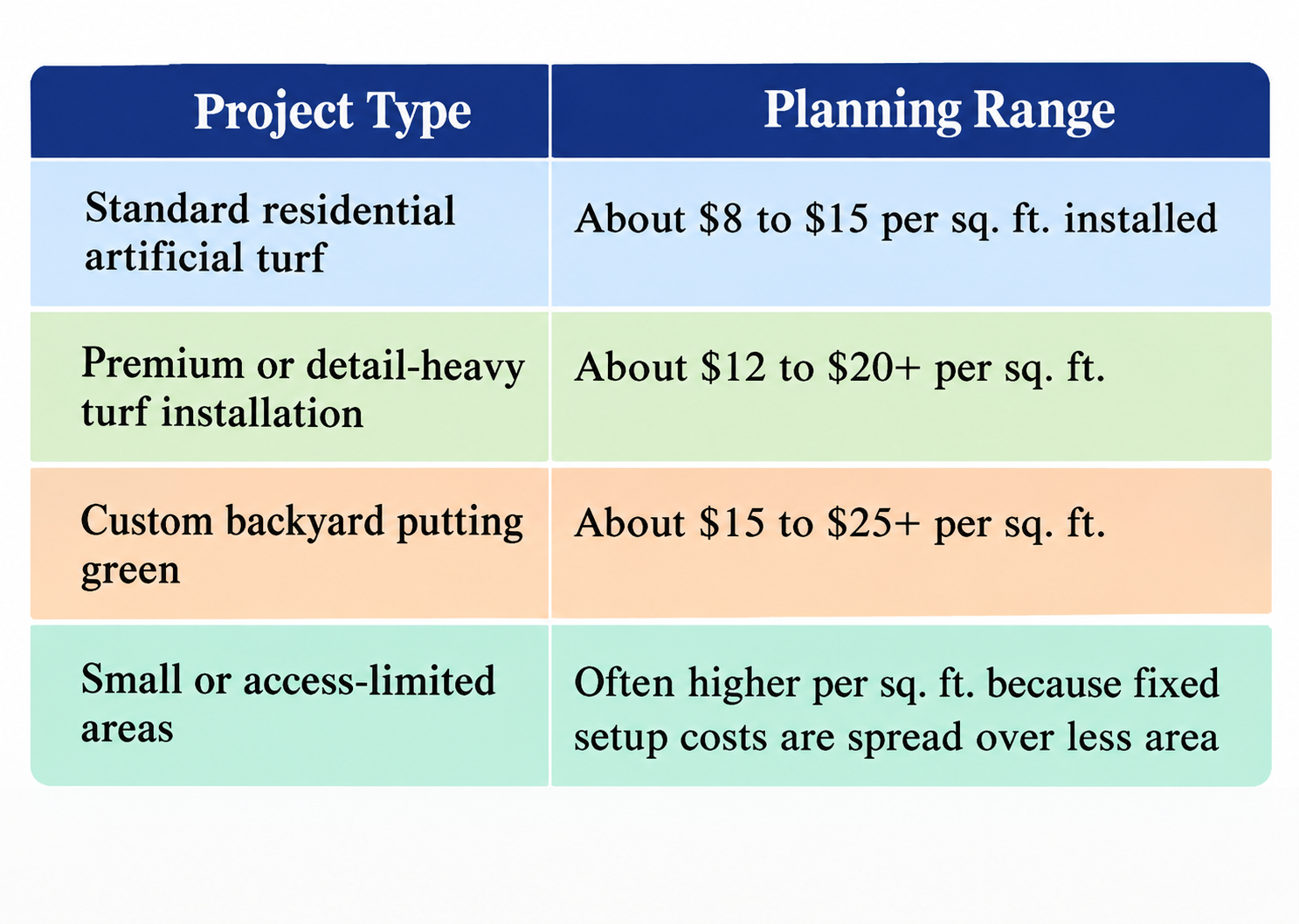
These figures are useful for early budgeting, not a substitute for an on-site proposal. The artificial turf installation cost per square foot depends on what has to happen below the visible turf as much as the turf product itself.
For example, an 800-square-foot area at $8 to $15 per square foot may land around $6,400 to $12,000, while a 1,200-square-foot lawn may fall around $9,600 to $18,000. Site complications or premium specifications can change those totals.
If you are asking, "how much does it cost to install artificial turf?" the most accurate answer starts with the size, current surface, intended use, drainage needs, and desired appearance.
Artificial grass installation cost includes more than the synthetic grass itself. A professional proposal may combine materials, site work, labor, and finishing details.
Existing sod, soil, roots, or other material may need to be removed before the new surface can be built. Deeper excavation or difficult haul-off conditions increase labor and disposal requirements.
An uneven or difficult site may therefore have a higher cost to install artificial grass than a clean, accessible area.
The base is one of the most important parts of the installation. Aggregate is placed and compacted to create a stable surface that supports the turf and helps reduce movement or settling.
Reducing base preparation may lower the initial turf installation cost, but it can increase the risk of low spots, shifting, or drainage problems.
East Texas can receive intense rain, so water management matters. Some sites need careful grading, while others may require added drainage components or tie-ins.
Vicente Outdoor Living includes drainage and base engineering as part of its turf capabilities. If an outdoor area also requires grade correction or structural support, a professionally planned retaining wall can sometimes become part of the larger landscape solution.
The visible portion of the project includes the selected turf, precise cuts, seams, edge securing, and infill. Curves, trees, pavers, beds, steps, and narrow transitions require more detail work than a simple rectangular lawn.
These finishing steps explain why artificial turf pricing should be compared by scope rather than by the turf roll alone.
A common source of confusion is the difference between artificial turf cost per square foot for material and turf installation cost per square foot for a completed project.
A low product price may cover only the grass, not excavation, base, compaction, grading, delivery, seaming, infill, edging, labor, or cleanup.
For homeowners comparing estimates, the better question is: "What is included in this artificial grass installation price?"
An installed quote should make the scope clear enough that you can compare contractors on similar work. If one proposal includes major base preparation and another does not, comparing only the bottom-line artificial grass cost per square foot can be misleading.
Every yard has its own conditions, but several factors regularly have the largest impact on residential artificial turf cost.
Larger areas usually cost more overall but may have a lower per-square-foot rate because mobilization, equipment, delivery, and crew setup are distributed across more square footage.
Very small courtyards, dog runs, side yards, or strips between hardscape can have a higher synthetic grass installation cost per square foot because the same setup work is required for a smaller finished area.
Removing healthy sod is different from correcting a deeply rutted, eroded, or poorly drained yard. Tree roots, old concrete, buried debris, steep slopes, or unstable areas can add labor and material.
The cost of installing synthetic grass becomes more site-specific when substantial correction is needed before the base can be built.
Turf products vary in blade shape, pile height, density, backing, drainage, texture, and heat performance. A decorative front yard may need a different product than a family play area, pet space, pool surround, or heavily traveled backyard. The goal is to match performance to the setting.
Water needs a reliable path away from structures and through or around the turf system. Drainage needs can be especially important in low areas, near patios, around pools, or where existing grade already causes standing water.
Additional aggregate, grade correction, drainage pipe, or other site-specific measures add labor and material, but can protect long-term appearance and function.
Turf that meets pavers, patios, planting beds, walkways, pool decking, or custom borders requires precise cuts and clean transitions. Detailed geometry also creates more material waste than an open rectangular lawn.
For homeowners creating a complete backyard rather than a single-surface project, Vicente Outdoor Living can coordinate turf with hardscaping, patios, structures, and other features so the final space feels intentionally designed.
Putting greens should not be priced exactly like standard lawn turf. A backyard green may require multiple turf types, contour shaping, cup placement, fringe areas, specialized base work, and careful attention to ball roll.
For 2026 planning, custom residential putting greens may start around $15 to $25 or more per square foot, depending on design and complexity. A simple practice green and a multi-break green with fringe, contours, and surrounding landscape features are very different projects.
The surface must support a specific playing experience. Elevation changes, drainage, speed, transitions, and cup locations all influence construction.
A putting green can also become a focal feature in a premium outdoor living plan. Integrating it with a patio, seating area, landscape beds, lighting, or an outdoor structure can create a more cohesive result.
Homeowners planning a larger transformation can explore Vicente Outdoor Living's outdoor living services for ideas that bring multiple features together.
Artificial turf installation in Tyler, TX should be designed around the actual property, not a generic statewide formula. Soil conditions, slope, tree coverage, drainage patterns, access, irrigation remnants, and adjacent hardscape can all influence the build.
The same applies to artificial grass installation in East Texas communities such as Bullard and Hideaway. Homes in The Cascades, Hollytree, Eagles Bluff, Oak Creek, and Cooks Crossing may have established landscaping, hardscape, pools, mature trees, or detailed finish requirements.
A premium installation should fit the architecture and landscape, including blade color, edge lines, transitions, planting beds, and surrounding materials.
You can review examples of Vicente Outdoor Living's broader craftsmanship in the project portfolio.
Artificial turf is not right for every property. It can be valuable when the goal is consistent appearance, reduced mowing, less mud, dependable coverage in difficult areas, or dedicated recreation space. A shaded side yard that repeatedly turns to mud has a different value calculation than a natural lawn that already performs well.
Artificial turf is low maintenance, not no maintenance. Debris still needs removal, fibers may need grooming, pet areas need cleaning, and occasional weeds can appear along edges. For a high-end property, good preparation and product selection help protect appearance over time.
The lowest turf installation cost does not always represent the lowest long-term cost. Before choosing a contractor, compare the actual scope of work.
Ask whether the proposal explains excavation depth, base material, compaction, drainage approach, turf product, infill, seam method, edging, disposal, cleanup, and any workmanship or manufacturer warranty information. Also ask how change orders are handled if unexpected site conditions are discovered.
A clear proposal helps explain why one cost to install artificial grass differs from another and whether an attractive price excludes important work.
For additional planning questions, Vicente Outdoor Living's FAQ page is a useful next step.
Square-foot averages help with early budgeting, but a site visit is more accurate. An installer can measure the area, evaluate access, inspect grade and drainage, identify transitions, and discuss how you will use the space.
Vicente Outdoor Living can also plan turf as part of a larger backyard that includes a putting green, patio, pergola, outdoor kitchen, retaining wall, or other feature.
If design coordination matters to your project, explore the company's outdoor design services before finalizing individual materials.
For a property-specific artificial turf installation cost in Tyler, Bullard, Hideaway, or surrounding East Texas communities, contact Vicente Outdoor Living to request an on-site consultation and detailed proposal. You can also view the company's Google Business Profile when researching local customer experiences.
For 2026 budgeting, a standard professional residential installation may fall around $8 to $15 per square foot. Premium products, difficult preparation, drainage work, detailed borders, or small project size can increase the artificial turf cost per square foot.
Using a broad planning range of $8 to $15 per square foot, a 1,000-square-foot area could be roughly $8,000 to $15,000. The real artificial turf installation cost depends on excavation, base work, access, drainage, turf selection, and finish details.
The total artificial grass installation cost usually increases with size, but the installed price per square foot can become more efficient on larger, straightforward projects because fixed setup costs are spread across more area.
Site preparation is one of the most commonly underestimated parts of artificial turf pricing. Removing existing material, correcting grade, building a compacted base, improving drainage, and disposing of debris can represent a meaningful portion of the project.
Usually, yes. Putting greens require specialized surfacing and more precise shaping than standard lawn turf. The synthetic grass installation cost may also include cups, fringe, contours, and additional base work to create the desired play characteristics.
Yes, when the base, drainage, edging, and transitions are designed correctly. Turf can work well beside patios, pool surrounds, walkways, and other hardscape, especially when those elements are planned together.
Request an on-site evaluation rather than relying only on an online square-foot figure. A detailed estimate should account for measurements, site access, removal, base depth, drainage, turf type, seams, infill, borders, and cleanup. That is the best way to understand the true artificial turf installation cost for your property.


